
By the Weather Shield Roofing team · Published November 2, 2026
The short answer
- Yes, you can put decorations on a Myrtle Beach roof. The rule is simple: nothing goes through the roof surface.
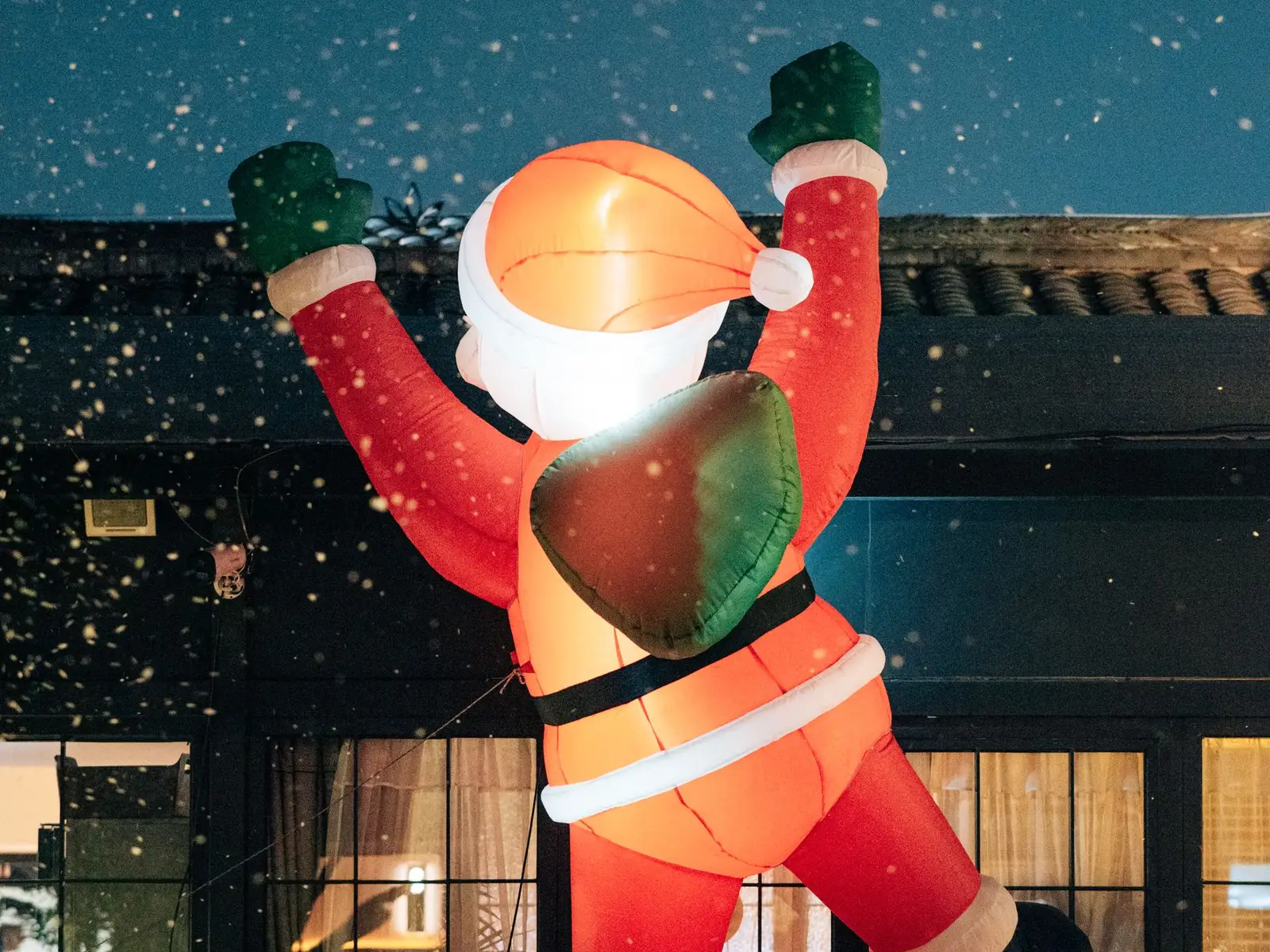
- Inflatables and Santa figures are sails. Tie them to ground stakes, porch posts or seam clamps, never to a nail in the shingles.
- On shingles, use clips on the shingle edge or the gutter. Skip nails, screws and staples. A cold morning makes shingles brittle.
- On standing seam metal, use clamps that grip the seam. On exposed-fastener metal, use magnetic clips on the screw heads. No new screws.
- On flat or low-slope sections, use weighted bases on a protective mat. Keep weight off drains and out of standing water.
- Projector lights, wreaths on walls and figures on the lawn give the look with nothing on the roof at all.
- Take it all down after New Year's and check for lifted shingles, holes, scratches and bent gutters. Call us if you find any.
Roof decorations in Myrtle Beach by the numbers
41 mph
Peak wind gust at North Myrtle Beach in November 2025, and again in December 2025
National Weather Service F-6 climate reports, read through the Iowa Environmental Mesonet archive.
14 days
Days in December 2025 with a gust of 25 mph or more
Counted from the daily peak-wind column of the same NWS report. November 2025 had 10 such days.
140–150 mph
Design wind speed lines across Horry County
150 mph along the beaches, 140 mph in the west. SC Building Codes Council wind map.
19°F
Lowest temperature at North Myrtle Beach in December 2025
Nine December mornings reached 32°F or below. NWS F-6 report. Cold shingles crack.
160 a day
Holiday decorating injuries treated in US emergency departments, on average
Over 40% involve falls. About 14,800 people in the 2021-22 season. CPSC, 2024.
835 fires
US home fires per year that started with decorations, not counting Christmas trees
An average of 3 deaths, 29 injuries and $18 million in damage a year. NFPA.
What can go on a roof, and how to attach it
Search this question and you get idea boards, retailer listings, video how-tos and a few roofer posts. Here is the same list from the roof's point of view: what each decoration is, where it can go, and what it does to the surface under it.
| Decoration | On the roof? | How |
|---|---|---|
| Inflatables (Santa, snowmen, reindeer) | Yes, with tie-downs to something solid | Lawn is best. On a roof, straps to a chimney, seam clamps or the deck below. Deflate on windy nights. |
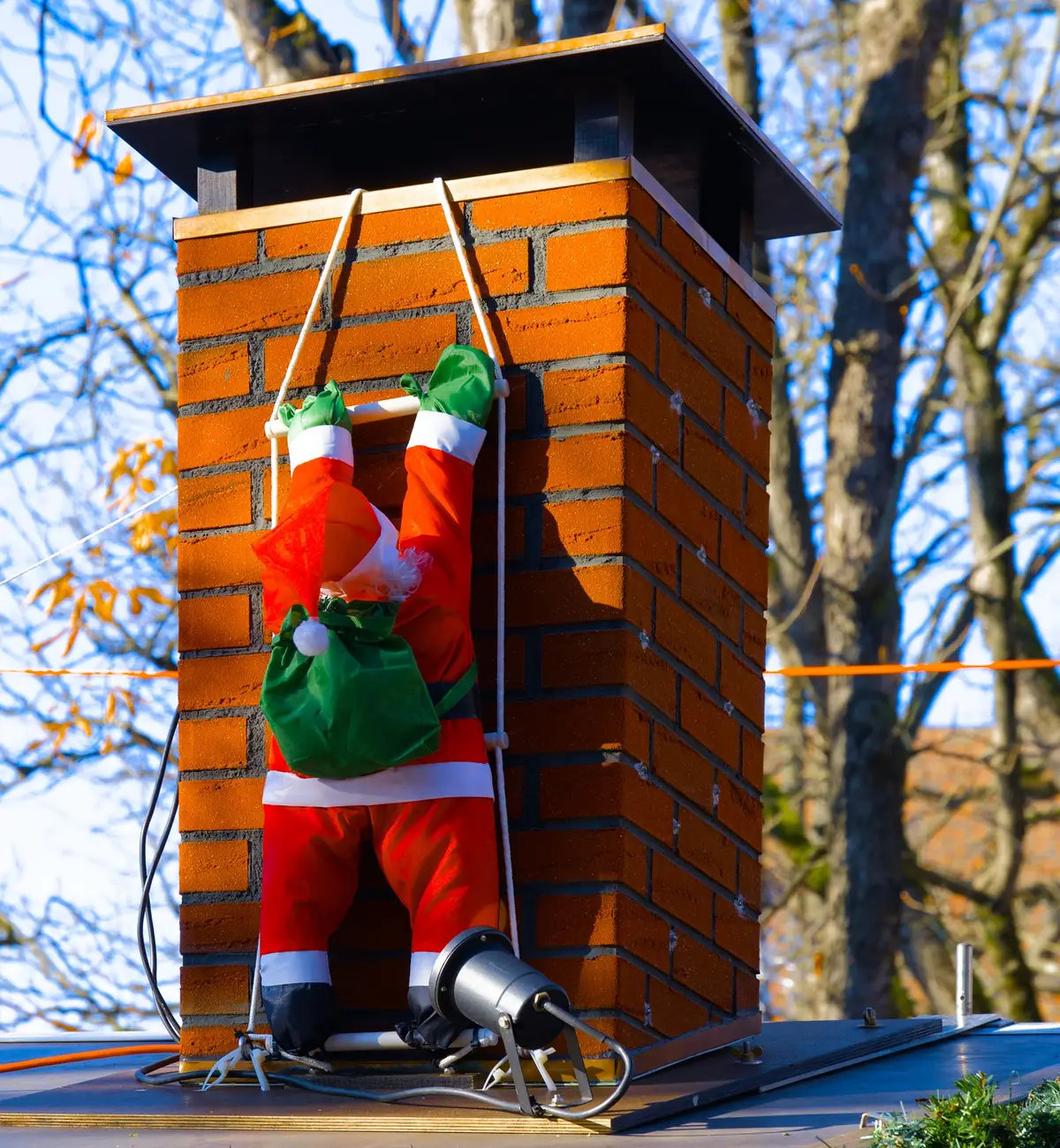
| Santa, sleigh and reindeer figures | Yes, on a frame or mat | Mount on a plywood or foam base that spreads the weight. Strap the base down; do not screw the feet to the roof. |
| Blow-mold figures (hollow hard plastic, lit from inside) | Yes, tied down, with the cord routed | Light and hollow, so wind moves them like a sail. Set on a mat, strap to a chimney or seam clamp, and run the cord so it cannot drag the figure. |
| Wreaths and garland | Yes, on walls, doors and gable peaks | Hang from a hook on trim or a wall clip, never from a nail in the roof. On a gable, use the fascia or a soffit hook. |
| Roofline lights (C7, C9, icicle) | Yes, with clips | Shingle clips, gutter clips, seam clamps or magnetic clips depending on the roof. No staples or nails. |
| Nets and rope light on the roof field | Only with weighted or clipped edges | A net left loose becomes a kite. Clip every edge or leave the field bare and light the roofline instead. |
| Projector lights | Yes, from the lawn | Stake in the yard, aim at the roof. Nothing touches the roof at all. |
| Anything screwed, nailed or stapled to the roof | No | Every hole is a leak path and a future repair. If you keep one rule, keep this one. |
Inflatables (Santa, snowmen, reindeer)
- On the roof?
- Yes, with tie-downs to something solid
- How
- Lawn is best. On a roof, straps to a chimney, seam clamps or the deck below. Deflate on windy nights.
Santa, sleigh and reindeer figures
- On the roof?
- Yes, on a frame or mat
- How
- Mount on a plywood or foam base that spreads the weight. Strap the base down; do not screw the feet to the roof.
Blow-mold figures (hollow hard plastic, lit from inside)
- On the roof?
- Yes, tied down, with the cord routed
- How
- Light and hollow, so wind moves them like a sail. Set on a mat, strap to a chimney or seam clamp, and run the cord so it cannot drag the figure.
Wreaths and garland
- On the roof?
- Yes, on walls, doors and gable peaks
- How
- Hang from a hook on trim or a wall clip, never from a nail in the roof. On a gable, use the fascia or a soffit hook.
Roofline lights (C7, C9, icicle)
- On the roof?
- Yes, with clips
- How
- Shingle clips, gutter clips, seam clamps or magnetic clips depending on the roof. No staples or nails.
Nets and rope light on the roof field
- On the roof?
- Only with weighted or clipped edges
- How
- A net left loose becomes a kite. Clip every edge or leave the field bare and light the roofline instead.
Projector lights
- On the roof?
- Yes, from the lawn
- How
- Stake in the yard, aim at the roof. Nothing touches the roof at all.
Anything screwed, nailed or stapled to the roof
- On the roof?
- No
- How
- Every hole is a leak path and a future repair. If you keep one rule, keep this one.
Clip types are real products: shingle clips, gutter clips and all-in-one clips for C7 and C9 bulbs (Christmas Lights Etc). Seam clamps for metal roofs are the same hardware used for snow guards and solar mounts (Sheffield Metals). The rest of the table is general roofing practice, not a figure from a study.
Weight, wind and where to tie down
Myrtle Beach winters are mild, but they are not calm. The numbers below are from the National Weather Service station at North Myrtle Beach, read from the daily wind columns of its monthly climate reports (November 2025, December 2025).
- The National Weather Service station at North Myrtle Beach recorded a peak gust of 41 mph in November 2025 and again in December 2025.
- In December 2025 the daily peak gust reached 25 mph or more on 14 days, and 30 mph or more on 5 days. November 2025 had 10 days at 25 mph or more.
- The monthly average wind sounds tame, about 6 mph both months, from the daily averages in the same reports. The gusts are what pull a decoration loose.
- Horry County's building code wind lines run from 140 mph in the west to 150 mph along the beaches. Your roof is built for that. A plastic Santa is not.
- An inflatable is a bag of air with a fan. In a gust it acts like a sail, and the only thing holding it is whatever you tied it to.
The county wind lines come from the SC Building Codes Council map for Horry County. For what those lines mean for a roof, see our SC wind zone roofing guide.
Where to anchor, by surface
On the lawn: stakes and sandbags
The safest spot for an inflatable is the ground. Use the stakes that came with it, or longer ones in sandy soil. Add a sandbag over each foot. Sand here drains fast and stakes loosen when it is dry.
On a porch or deck: posts and rails
Strap to a post, not a rail cap. Use ratchet straps or rope with a knot you can undo, and pad the strap where it crosses a painted surface.
On a shingle roof: the chimney, the ridge vent zone, or nothing
Loop straps around a brick chimney with corner pads. Never drive a stake, nail or screw into the shingle field. If there is no chimney, keep the inflatable on the ground.
On a standing seam metal roof: seam clamps
Clamps that grip the raised seam hold without a single hole. Sheffield Metals, a metal roof maker, points to this kind of non-penetrating mount for anything added to a standing seam roof.
On a flat or low-slope roof: weighted bases on a mat
Set a rubber mat or carpet scrap under a weighted base. Keep the weight off drains and scuppers. Do not use concrete blocks straight on the membrane.
Every night the forecast says wind
Unplug the fan and let the inflatable lie down, or bring it in. A deflated Santa cannot sail. Watch the forecast for gusts over 25 mph.
Asphalt shingle roofs: clips, cold mornings and the sealant strip
Architectural shingles hold a decoration fine as long as you work with the shingle, not through it. The cold-weather points come from the Asphalt Roofing Manufacturers Association, the shingle makers' trade group.
- Use clips that hook the bottom edge of a shingle or the gutter lip. Christmas light sellers make shingle clips, gutter clips and all-in-one clips for C7 and C9 bulbs.
- No staples, no nails, no screws. Christmas Lights Etc, a lights retailer, says plainly that staples and nails can damage your home and your lights.
- Cold makes shingles stiff. The Asphalt Roofing Manufacturers Association says shingles become less flexible as temperature drops and may crack when handled.
- Decorate on a mild afternoon, not a frosty morning. December 2025 had nine mornings at or below freezing at North Myrtle Beach.
- Walk as little as possible. ARMA warns that roof traffic in cold weather can break the sealant bond between shingle courses, and curved or buckled shingles break underfoot.
- Do not pry up a shingle tab to slide a clip under it. The sealant strip is what holds that shingle in a gust, and once broken it may not re-seal on its own.
- Keep figures and bases off the shingle field. If a sleigh has to sit on the roof, put it on a wide base at the eave with straps to a chimney or the deck below.
Already have holes from last year? A nail hole in a shingle does not always leak right away, so a dry December says nothing about March. Our roof repair team seals or replaces those shingles before the spring rains.
Metal roofs: standing seam and exposed fastener
Metal roofs are common on newer coastal homes here. There are two kinds, and the rules differ. The system descriptions below come from Sheffield Metals, a metal roof panel maker, and its maintenance guide.
Standing seam (raised seams, no visible screws)
Use clamps that grip the seam. Sheffield Metals describes standing seam as a concealed-fastener system with no holes in the panels, and names non-penetrating clamps as the way to mount solar, snow guards and other add-ons. Light clips that pinch the seam work the same way.
Exposed fastener (screws through the panel)
Use magnetic clips on the screw heads and ribs, or clips on the eave trim. Sheffield says exposed-fastener panels already carry many holes and that leaks at those holes are the system's most common problem. Do not add more.
Never drive a new screw
A screw through a panel is a permanent hole. Sheffield's maintenance guide says any penetration added to a metal roof should be handled by a professional roofing contractor.
Protect the paint
Dragging a strap, a ladder or a sleigh base across a painted panel scratches the finish. Sheffield's guide notes that scratches and scuffs on the paint system are typically not covered by the maker. Pad every contact point.
Oil canning is not your fault
Wavy flat areas on a metal panel are called oil canning. Sheffield links it to restricted thermal movement of the panel, which is one more reason to keep anything you add at the seams and eaves rather than pinned to the field of a panel.
Metal is slick
Dew, frost and salt haze make a metal roof slippery. Do not walk on a metal roof to decorate it; work from a ladder at the eave or from the ground with a pole.
Found a screw hole, a loose panel or a long scratch after the holidays? That is what our metal roof repair service is for. For the differences between the two systems on a coastal house, see standing seam vs corrugated metal.
Flat and low-slope sections: no punctures, weighted bases, no ponding
Porch roofs, additions and many condo buildings along the Strand have flat or low-slope sections covered by a membrane. A membrane forgives nothing sharp. These are the rules that keep a low-slope roof watertight through December.
- No punctures. A TPO, PVC or modified bitumen membrane is a set of sheets joined at lap seams, and the field and the seams are both the roof. A stake, screw or dropped bracket opens it.
- Use weighted bases on a mat. A rubber mat or a scrap of carpet under each base spreads the load and keeps grit from grinding into the membrane.
- Keep everything away from drains and scuppers. A base, a cord or a loose net over a drain backs water up onto the roof.
- Watch for ponding. Water that sits more than a day or two after rain is a roof problem on its own. Decorations that trap leaves make it worse.
- Mind the seams. Set bases on the field of the sheet, not across a lap seam, where the extra weight and movement works at the bond.
- Lift, do not drag. Dragging a sleigh or a weighted base across the membrane scuffs the top layer.
One more metal note that applies here: Sheffield says exposed-fastener metal needs at least a 3/12 slope so water sheds instead of pooling on the screw holes. If your low-slope section is screwed-down metal, keep every decoration off it.
Gutters and fascia: light loads only
- Gutter clips hang lights from the lip without a hole. They are made for C7, C9 and icicle strings. Weight stays light.
- Do not hang inflatables, garland rolls or figures from the gutter. Gutters here are held by spikes or hidden hangers meant for water, not for a sail.
- Keep extension cords out of downspouts. A cord in a downspout blocks the next rain and a December storm here can drop close to an inch in a day.
- Clean the gutters before you clip to them. Full gutters are heavier, and you will be back on the ladder in January anyway.
- Fascia hooks are fine for a wreath on a gable, as long as they screw into the fascia board and not into the drip edge or shingles.
The rain figure is from the same NWS report: the biggest one-day total at North Myrtle Beach in December 2025 was 0.95 inch (NWS F-6, December 2025).
Lights, cords and outlets, briefly
This guide is about decorations, so we keep the lights short. Two of the rules below are the CPSC's (Nov. 2024 holiday release): never string more than three incandescent sets together, and never overload an outlet. The rest is general outdoor-wiring and placement practice.
- The CPSC's rule for incandescent strings: never connect more than three sets end to end, and never overload an outlet. LED sets carry their own limit on the tag. Follow it.
- Plug outdoor strings and the inflatable's fan into an outdoor-rated outlet with ground-fault protection. If your exterior outlets are the old kind without a test button, an electrician can swap them.
- Use cords marked for outdoor use, and route them so they never cross a walkway, a gutter outlet or a downspout.
- Point C9 bulbs out or down so the socket drains. A socket that holds water on a roofline trips the circuit.
- Metal roof? Put the cord on the trim and clamps, never under a panel edge where it can chafe.
- A roofline string is a decoration, not a fastener. Never use it to steady a figure or an inflatable.
The no-roof-damage options
Plenty of well-decorated houses never put a thing on the roof. From the street, these read the same.
- Projector lights from the lawn. Snowflakes, stars or a full scene on the roof, with nothing touching it.
- A lit wreath on each window or gable, hung from a wall hook or a fascia hook.
- Santa, sleigh and reindeer on the lawn or across the front walk, staked where you can reach them.
- A column of inflatables along the driveway, each one tied to two stakes and a sandbag.
- Gutter-clipped lights along the roofline, which read as a lit roof from the street.
- Lit garland on the porch rail and columns, where you can plug it in at ground level.
Falls, fires and ladders
The injury and fire numbers are national, from the CPSC (and its 2014 breakdown) and the NFPA. The ladder rules are the American Ladder Institute's.
- The CPSC counts about 160 holiday decorating injuries a day in the US, and over 40% involve falls. About 14,800 people went to emergency departments in the 2021-22 season.
- In the CPSC's earlier breakdown, falls were 34% of decorating injuries, cuts 11% and back strains 10%.
- The NFPA counts an average of 835 US home fires a year that started with decorations other than trees, causing 3 deaths, 29 injuries and $18 million in damage.
- Ladder rules from the American Ladder Institute: firm, level ground; a duty rating above your weight plus tools; never stand on the top rung; keep three points of contact.
- Do not carry anything in your hands on the ladder. Hoist it on a rope after you are up, or pass it to a helper.
- Hire it out when the roof is steep, metal, two stories or wet. A pro display installer or a roofer with a harness is cheaper than a fall.
What decorations do to a roof, and what to check in January
A roof leak that shows up in January and only when it rains hard can trace back to a December fastener hole or a lifted shingle. When the decorations come down, look for these six things from the ground or a ladder, never from the roof itself.
Fastener holes
Any nail, screw or staple that went into shingles, a panel or a membrane. Each one needs sealing or a patch before spring rains.
Lifted or torn shingle tabs
Clips pulled hard, straps dragged or a figure slid off the roof. Lifted tabs lose their seal and go first in the next storm.
Scratched or dented metal panels
A scratch through the paint rusts from the edges. A dent at a seam can hold water. Both are worth a touch-up or a look.
Bent or pulled gutters
A gutter that sags or pulls away from the fascia after the holidays was carrying more than lights.
Membrane scuffs, cuts or ponding
On a flat section, look where bases sat and where cords ran. Standing water after a dry day means a drain or low spot needs attention.
Debris and clogged drains
Nets, cords and bases trap leaves. Clear every valley, gutter and scupper when the decorations come down.
Found one? Request a roof inspection and we will check the whole roof, not just the spot. Water coming in right now, before we can get there? Use our emergency roof repair line.
Questions people ask about roof decorations
Can you put Christmas decorations on a roof without damaging it?
Yes, if nothing goes through the roof surface. Use clips on shingle edges and gutters, seam clamps on standing seam metal, magnetic clips on exposed-fastener metal and weighted bases on a mat on flat sections. Tie inflatables and figures to a chimney, posts, seam clamps or ground stakes, never to a nail or screw in the roof. Take everything down in January and check for lifted shingles, holes and scratches.
How do you keep a Santa inflatable from blowing off the roof?
Tie it to something that is not the roof surface: a chimney with padded corners, a seam clamp on a metal roof, or a strap down to a deck post. Use the tethers from the box plus a strap on each side. When the forecast calls for gusts, unplug the fan so it lies flat. In December 2025 the NWS station at North Myrtle Beach logged 14 days with gusts of 25 mph or more and a peak of 41 mph. On a shingle roof with no chimney, keep the inflatable on the lawn.
How do you attach Christmas decorations to a shingle roof?
With clips, not fasteners. Shingle clips hook the bottom edge of a shingle, gutter clips hook the gutter lip, and all-in-one clips do both for C7 and C9 bulbs. Figures sit on a wide base at the eave, strapped to a chimney or the deck below. Never nail, screw or staple into shingles, and never pry up a tab to slide something under it.
Can you hang Christmas lights on a metal roof?
Yes. On a standing seam roof, use clamps or clips that grip the raised seam. On an exposed-fastener roof, use magnetic clips on the screw heads and ribs, or clips on the eave trim. Never drive a new screw through a panel, and pad anything that touches the paint. Sheffield Metals, a metal roof maker, describes standing seam as a system with no holes in the panels and points to non-penetrating clamps for anything mounted on it.
Should C9 bulbs point up or down on the roofline?
Down or out, so the socket drains. A socket that holds rainwater trips the circuit or corrodes. Most all-in-one clips are made to hold a C9 bulb pointing out from the roofline, which reads the same from the street.
How do you keep icicle lights from blowing up onto the roof?
Clip them every few inches along the gutter lip or shingle edge, not just at the ends. In a gust the slack between clips lifts. Shorter runs between plugs also help, because a long loose run swings as one piece. Take down any run that keeps lifting, since it will scrape the shingle granules each time.
Can I hang Christmas lights without gutters?
Yes. Shingle clips hook the bottom edge of the first course of shingles and hold a C7 or C9 string along the eave. Fascia hooks screwed into the fascia board also work for a string or a wreath. Do not nail or staple into the drip edge or the shingles.
Can you put Christmas decorations on a flat roof?
Lightly. Use weighted bases set on a rubber mat or carpet scrap, keep everything away from drains and scuppers, and never stake, screw or drop a bracket into the membrane. Lift bases rather than dragging them. If water sits on the roof more than a day or two after rain, fix that before you decorate.
Is it safe to put Christmas decorations on a roof myself?
It depends on the roof and the weather. The CPSC counts about 160 holiday decorating injuries a day, and over 40% involve falls. Steep, metal, wet or two-story roofs are jobs for a pro with a harness. On a low single-story shingle roof, work from a ladder on firm ground with three points of contact and keep your hands free while climbing.
What are the plastic outdoor Christmas decorations called?
Blow molds. The CBC describes them as "hollow, hard plastic lawn decorations that light up from the inside," and the name comes from how they are made: melted plastic blown into a mold. The Journal of Antiques lists the other names people use, "Light-ups, lawn art, plastic kitsch, illuminated figures, or simply blow molds." On a roof a blow mold behaves like a light sail: set it on a mat, tie it to a chimney or a seam clamp, and route the cord so it cannot drag the figure. Never fix one with a screw or nail through the roof.
Does Weather Shield Roofing hang Christmas decorations?
No. We are roofers, not a display company. What we do is inspect the roof before and after the holidays, repair any holes, lifted shingles, scratched panels or bent gutters the decorations leave behind, and fix the leak if one shows up. Call (843) 877-5539 or request a roof inspection online.