
Winter Storm Gianna Roof Damage: What Myrtle Beach Homeowners Should Check Now
Shocking Industry Truth
On January 30 through February 1, 2026, Winter Storm Gianna — a historic bomb cyclone — dumped record snowfall across the Grand Strand. The National Weather Service confirmed 5 inches of snow in Myrtle Beach, 8 inches in North Myrtle Beach, 5.5 inches in Socastee, and roughly 6 inches in Longs. For context, this was the most significant snowfall to hit the broader Grand Strand since December 1989, with areas like North Myrtle Beach exceeding the totals from the January 2025 storm.
Two weeks have passed since the storm. The snow has melted. And right now, hidden damage may be silently worsening on your roof. The AAA issued a warning on February 2, 2026, urging Carolinas homeowners to watch for ice dam damage specifically caused by Storm Gianna. The Insurance Institute for Business and Home Safety (IBHS) in Richburg, SC, confirmed that freeze-thaw cycles from this storm are causing shingles to unseal and allowing water intrusion that homeowners cannot see from the ground.
This is not a generic winter storm article. This is a specific guide for Myrtle Beach, North Myrtle Beach, Conway, Surfside Beach, and Grand Strand homeowners who lived through Storm Gianna and need to know what to check on their roofs right now — before minor damage becomes a major problem.
Time-Sensitive: Post-Storm Inspection Window
Most South Carolina homeowners insurance policies require you to report storm damage promptly. Waiting too long can give your insurer grounds to deny your claim. If you suspect any roof damage from Winter Storm Gianna, schedule a professional inspection now. Call WeatherShield Roofing at (843) 877-5539 for a free post-storm roof inspection.
This article is part of our storm damage content cluster. For related topics, see our guides on how to spot hidden roof damage after a storm, what to do 24 hours after storm roof damage, repair vs. replace after storm damage, and our complete roof insurance claim guide for Myrtle Beach.
Ready to Protect Your Investment?
Schedule your free roof inspection today. No obligations, just peace of mind.
What Winter Storm Gianna Did to Myrtle Beach Roofs
Winter Storm Gianna was not a typical coastal storm. It was classified as a bomb cyclone — a rapidly intensifying low-pressure system that strengthened off the Southeast coast. According to the National Weather Service Wilmington office, the storm brought a combination of heavy snow, high winds, and extreme cold that our coastal roofs were never designed to handle.
Here is what the NWS recorded across the Grand Strand and surrounding areas:
| Location | Snowfall | Source |
|---|---|---|
| North Myrtle Beach | 8.0 inches | NWS Wilmington |
| Loris | 7.0 inches | NWS Wilmington |
| Longs | 6.0 inches | NWS Wilmington |
| Aynor | 5.5 inches | NWS Wilmington |
| Socastee | 5.5 inches | NWS Wilmington |
| Myrtle Beach | 5.0 inches | NWS Wilmington |
| Socastee (south) | 4.5 inches | NWS Wilmington |
| Little River | 5.5 inches | NWS Wilmington |
After the snow, temperatures plummeted. Parts of the region dropped below zero — Lumberton, NC, recorded -1 degrees Fahrenheit on February 2, setting a record low. These extreme temperature swings after heavy snowfall are exactly what causes the most insidious type of roof damage: freeze-thaw cycling.
The problem with coastal South Carolina roofs is that they are engineered primarily for heat, humidity, wind, and rain — not for prolonged snow loads and subfreezing temperatures. Most Grand Strand homes use standard three-tab or architectural asphalt shingles with 15-pound underlayment. These materials handle hurricanes, but a bomb cyclone with 5 to 8 inches of snow and days of subfreezing temps creates stresses these roofs were not built to withstand.
5 Types of Roof Damage Winter Storm Gianna Caused
Based on the inspections we have conducted across the Grand Strand since Storm Gianna, here are the five most common types of damage we are finding:
1. Ice Dam Formation and Water Intrusion
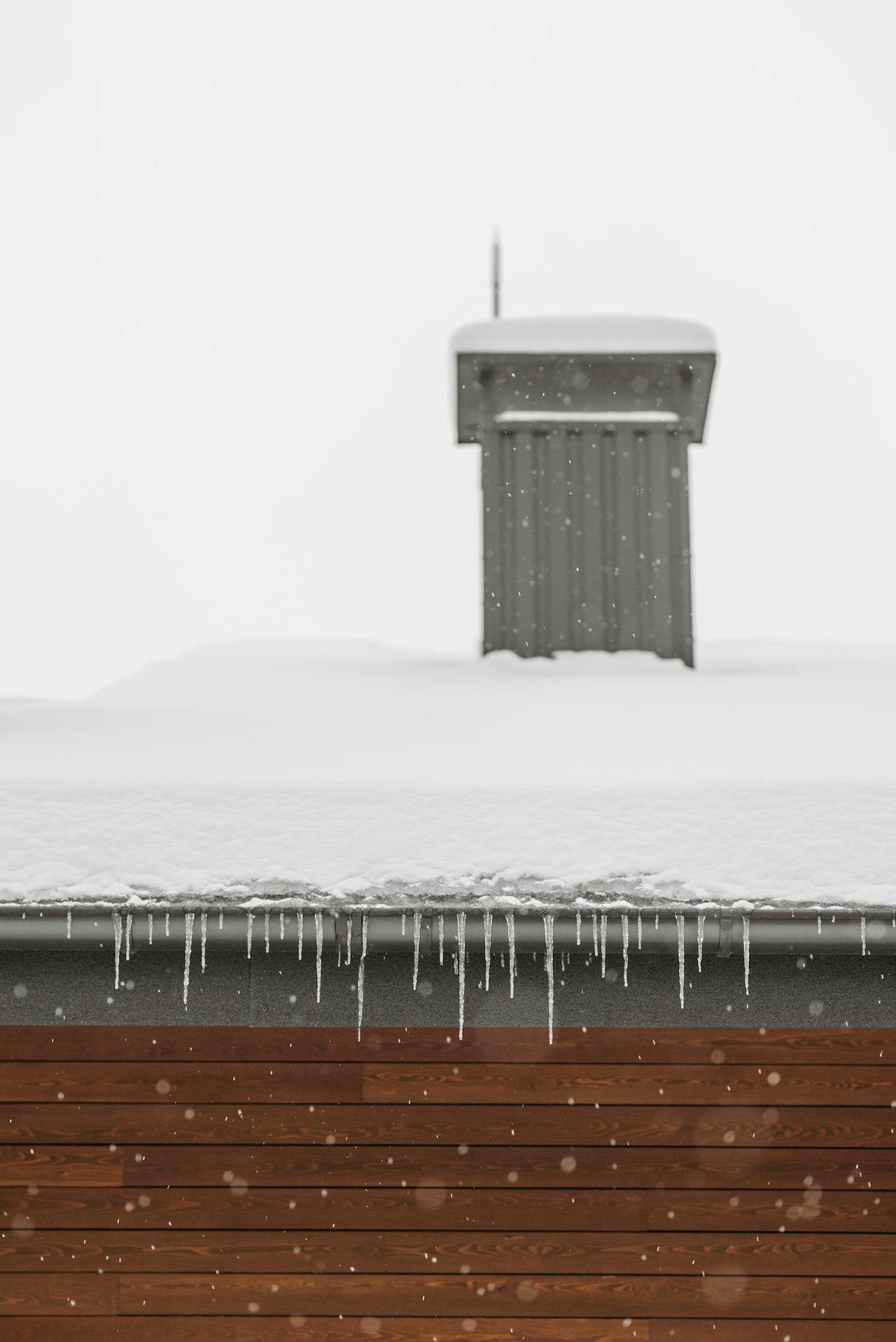
AAA issued a specific warning on February 2, 2026, urging Carolinas homeowners to watch for ice dams following Storm Gianna. Ice dams form when heat from inside your home melts snow on the roof. The meltwater flows down to the colder eaves and refreezes, creating a ridge of ice that blocks drainage. Additional meltwater backs up behind the dam and works under your shingles, leaking into your attic and living spaces.
AAA Director of Public Affairs Tiffany Wright stated in their February 2 advisory that ice dams can rot roof decking and pull gutters away from the structure. Once water seeps in, homeowners may face peeling paint, warped floors, and mold growth.
Signs of Ice Dam Damage to Look For
- Water stains on ceilings or walls, especially near exterior walls
- Peeling paint or bubbling drywall near the roofline
- Damp or discolored insulation in the attic
- Gutters that appear bent, sagging, or pulled away from the fascia
- Ice residue or water marks along the roof edge or soffit area
2. Freeze-Thaw Shingle Damage
The IBHS (Insurance Institute for Business and Home Safety) in Richburg, SC, demonstrated to WSOC-TV on February 8, 2026, how freeze-thaw cycles cause shingle damage. IBHS research project scientist Jake Sorber explained that when water gets under shingles and repeatedly freezes and thaws, it breaks the adhesive seal that holds shingles together.
Sorber noted that their testing on aging roof farms shows that shingles at 10 years show significantly more unsealing than at five years. For homes across the Grand Strand that already have 10 to 20-year-old roofs weathered by salt air and UV exposure, the freeze-thaw cycles from Storm Gianna may have accelerated existing degradation.
Once shingles unseal, they become vulnerable to wind uplift. According to IBHS, if storm winds blow off unsealed shingles, the last line of defense is typically a 15-pound barrier held on by staples — which can easily come off in high winds, exposing your roof deck to water intrusion.
3. Snow Load Stress on Roof Structure
Snow can weigh anywhere from about 3 to 20 pounds per cubic foot depending on type — fresh, fluffy snow on the low end (3 to 5 lbs) and wet, packed snow on the high end. The NWS described the snow from Storm Gianna as dry and fluffy with snowfall ratios around 15:1, which puts it on the lighter end. However, even at lower density, 5 to 8 inches of snow across an entire roof adds hundreds of pounds of weight that Grand Strand roofs rarely experience.
Look for signs of structural stress: sagging ridgelines, cracked interior drywall (especially at ceiling-wall junctions), doors or windows that suddenly stick, and visible deflection in roof rafters when viewed from the attic.
4. Gutter and Downspout Damage
Gutters packed with ice and snow take on enormous weight. We are seeing gutters across the Grand Strand that have pulled away from fascia boards, cracked at seams, or developed reverse slopes that now direct water toward the foundation instead of away from it. Downspouts that froze and expanded may have cracked joints or disconnected sections.
5. Flashing and Vent Boot Failures
The metal flashing around chimneys, skylights, dormers, and wall-roof intersections expands and contracts at a different rate than the surrounding roofing material. The extreme temperature swings from Storm Gianna — from well below freezing to daytime thaw and back again — stress these transitions. The rubber boots around plumbing vents and exhaust pipes are particularly vulnerable, as the cold can crack aged rubber that was already degraded by Myrtle Beach UV and salt exposure.
Your Complete Post-Storm Roof Inspection Checklist
You can safely perform the exterior ground-level and interior inspections yourself. Do not climb onto your roof — leave that to professionals with proper safety equipment. Here is what to check:
Exterior Ground-Level Inspection
- ☐Shingles: Look for missing, cracked, curled, or displaced shingles. Use binoculars if needed. Pay attention to shingle edges — freeze-thaw damage often causes edge lifting that is visible from the ground as a shadow line.
- ☐Granule loss: Check your gutters and downspout discharge areas for piles of shingle granules. Some granule loss is normal, but heavy accumulation after a storm indicates shingle surface damage.
- ☐Gutters: Walk the perimeter and check that all gutters are still firmly attached, slope toward downspouts, and show no cracks or separations at seams.
- ☐Downspouts: Verify all connections are intact and that water flows freely. Run a hose to test drainage.
- ☐Soffit and fascia: Look for water stains, peeling paint, sagging sections, or visible rot — signs that water has been getting behind the gutter line.
- ☐Flashing: Visually inspect the metal flashing around chimneys, dormers, vents, and wall intersections for gaps, lifting, or rust.
- ☐Debris: Check for broken tree branches resting on or near the roof that may have caused impact damage you cannot see from below.
Interior Inspection
- ☐Ceilings: Walk every room and look up. Check for new water stains, discoloration, bubbling paint, or sagging drywall — especially in rooms directly below the roof or near exterior walls.
- ☐Walls near roofline: Check the top foot of interior walls for moisture, peeling paint, or a musty smell that could indicate water running down from a roof leak.
- ☐Windows and doors: Check for new sticking or misalignment, which can indicate structural movement from snow loading.
- ☐Closets and corners: These are where leaks often show first because they are less trafficked. Check ceilings in closets near exterior walls.
Attic Inspection
- ☐Daylight test: Turn off lights and look for any daylight coming through the roof boards. This indicates gaps where water can enter.
- ☐Insulation: Check for damp, compressed, or discolored insulation. Wet insulation loses its R-value and indicates active water intrusion.
- ☐Roof deck: Look for dark stains, mold growth, or soft spots on the underside of the roof sheathing.
- ☐Rafters and trusses: Check for any new cracks, sagging, or signs of stress from snow loading.
- ☐Ventilation: Verify that soffit vents and ridge vents are not blocked by displaced insulation. Proper ventilation prevents future ice dam formation.
Free Post-Storm Roof Inspection
If you find any warning signs during your self-inspection — or if you want professional confirmation that your roof is sound — WeatherShield Roofing offers free post-storm roof inspections for Grand Strand homeowners. We document everything with photos for your records and insurance purposes. Call (843) 877-5539 to schedule.
Insurance Claim Deadlines After Storm Gianna
If your inspection reveals damage, timing matters for your insurance claim. South Carolina homeowners insurance policies typically require prompt notice of damage. While there is no single statewide statute defining an exact deadline for reporting property damage, most SC insurers require notification within a reasonable time — generally interpreted as days to weeks, not months.
Here is what you should do if you find storm damage:
Step-by-Step: Filing a Storm Gianna Insurance Claim
- 1Document everything: Take photos and video of all damage — exterior, interior, and attic. Include wide shots for context and close-ups for detail. Photograph your address or a landmark in the same frame to establish location.
- 2Call your insurance company: Report the damage and open a claim. Ask about their specific deadline requirements and what documentation they need.
- 3Get a professional inspection: Before the adjuster visits, have a licensed roofing contractor inspect and document the damage independently. This gives you a baseline to compare against the adjuster's assessment.
- 4Prevent further damage: Make temporary repairs if needed (tarping, catching leaks) and save all receipts. Your policy requires you to mitigate further damage, and most policies cover reasonable temporary repair costs.
- 5Keep records: Save every communication with your insurer — emails, letters, phone call dates, names of representatives, and claim numbers.
AAA noted in their February 2 advisory that many homeowners insurance policies cover ice-related damage, but exclusions vary by policy. Even if you do not have current damage, reviewing your policy now helps you understand where you stand before the next weather event.
For detailed guidance on the insurance claim process, see our complete roof insurance claim guide for Myrtle Beach and our guide on filing a roofing insurance claim step by step.
How to Protect Your Roof Before the Next Winter Storm
Storm Gianna caught the Grand Strand off guard because snow events of this magnitude are so rare here. But climate patterns are shifting, and the IBHS recommends proactive steps to protect your roof from future winter weather events.
Ice Dam Prevention (AAA Recommendations)
AAA published specific prevention recommendations for Carolinas homeowners after Storm Gianna. The most effective long-term prevention is keeping the roof temperature consistent with the eaves:
- Improve attic ventilation: Ensure you have adequate soffit, gable, or ridge vents. Proper ventilation keeps the roof deck cold, preventing uneven snowmelt that causes ice dams.
- Check insulation depth: Attic insulation should not block soffit vents. The insulation prevents heat from your living space from warming the roof deck unevenly.
- Seal air leaks: Gaps around attic hatches, recessed lights, plumbing penetrations, and ductwork allow warm air into the attic. Sealing these reduces the heat that causes ice dams.
- Ensure exhaust fans vent outside: Bathroom and kitchen exhaust fans must vent to the exterior, not into the attic. Moisture-laden air dumped into the attic accelerates condensation and ice dam formation.
Upgrade to FORTIFIED Roof Standards
The IBHS recommends a FORTIFIED roof for homes in areas that experience severe weather. IBHS researcher Jake Sorber explained that standard roofs use 15-pound barriers held on by staples — which can fail when exposed to wind or water intrusion. FORTIFIED roofs use 30-pound barriers with stronger fasteners and extra sealing to keep water out even if shingles are compromised.
South Carolina homeowners may qualify for the SC Safe Home Grant, which provides funding for wind-mitigation upgrades that align with FORTIFIED standards. Some SC insurers also offer premium discounts for FORTIFIED-designated roofs.
For a complete guide to FORTIFIED roofing, see our FORTIFIED roof complete guide for Myrtle Beach.
Annual Maintenance Matters More Now
Storm Gianna proved that extreme weather can strike the Grand Strand in any season. Regular roof maintenance is your best defense:
- Schedule professional roof inspections at least once a year and after every major storm event
- Keep gutters clean and ensure proper drainage year-round
- Trim tree branches that overhang the roof to prevent impact damage and debris accumulation
- Address minor repairs immediately — a missing shingle or cracked flashing that seems harmless in fair weather becomes a significant vulnerability during storms
For a seasonal maintenance schedule tailored to coastal SC, see our roof maintenance checklist guide for Myrtle Beach.
Why Acting Now Matters: The Hidden Cost of Waiting
Here is the reality that many Grand Strand homeowners are facing right now: Storm Gianna caused damage that is invisible from the ground. The freeze-thaw cycles broke shingle seals. Ice dams pushed water under roofing materials. And every rain event since the storm has been compounding that damage.
A small leak that starts as a damp spot in your attic insulation can become a mold problem within weeks. A cracked flashing that lets in a trickle of water can rot your roof deck over a season. And shingles with broken seals that survived Storm Gianna may blow off entirely during the first strong thunderstorm of spring.
The Bottom Line
The best time to inspect your roof was the day after Storm Gianna. The second best time is today. Every day you wait, minor damage has the potential to become major — and your insurance claim becomes harder to connect to the original storm event. A 30-minute self-inspection using the checklist above costs you nothing. And if you find anything concerning, a professional inspection gives you documentation and peace of mind.
WeatherShield Roofing has been inspecting roofs across the Grand Strand since Storm Gianna hit. We are seeing damage patterns consistent with everything described in this article. If your home is in Myrtle Beach, North Myrtle Beach, Conway, Surfside Beach, Carolina Forest, Socastee, Longs, Little River, or anywhere on the Grand Strand, call (843) 877-5539 for a free post-storm roof inspection.
The Cost Comparison: Maintenance vs. Neglect
Without Maintenance
- Roof lifespan: 12-15 years
- Insurance claims often denied
- Emergency repairs cost 3x more
- Property value decreases by 5-10%
- Warranty becomes void
- Total 20-year cost: $382
With Regular Maintenance
- Roof lifespan: 25-30+ years
- Insurance claims approved
- Prevent costly emergencies
- Property value protected
- Full warranty coverage maintained
- Total 20-year cost: $8,000-10,000
Need a roofer?
Call (843) 877-5539 for a free estimateNeed Professional Help?
WeatherShield Roofing is Myrtle Beach's highest-rated roofing company with a perfect 5.0-star Google rating. We can help with any roofing need:
Frequently Asked Questions
About the Author
David Karimi
Owner, WeatherShield Roofing
David Karimi is the owner of WeatherShield Roofing in Myrtle Beach, SC. He has inspected hundreds of storm-damaged roofs across the Grand Strand and helped homeowners navigate insurance claims after hurricanes, hailstorms, and the unprecedented Winter Storm Gianna. David holds SC residential roofing credentials and understands the unique challenges coastal roofs face from salt air, humidity, and extreme weather events.
The Bottom Line: Your Roof, Your Choice
Every day you wait is another day closer to that emergency call no homeowner wants to make. The statistics are clear: 80% of roofs fail prematurely, and 61% of homeowners can't afford the emergency repairs that follow.
What You Get with Weather Shield Roofing:
Don't Wait Until It's Too Late
Join thousands of smart Myrtle Beach homeowners who protect their investment with regular maintenance.
Emergency? Call our 24/7 hotline: (843) 877-5539
Our Roofing Services
Serving the Grand Strand
Weather Shield Roofing proudly serves homeowners across the Grand Strand and surrounding communities. Find your local roofing experts:
Related Articles

Hurricane Roof Damage in Myrtle Beach: What to Do First (2026 Guide)
Hurricane roof damage in Myrtle Beach? Step-by-step guide: emergency tarping, SC insurance claims, damage by hurricane category, storm chaser warnings & when to call a roofer. Call (843) 877-5539.
Storm Damage Roof Repair in Myrtle Beach: Complete 2026 Guide
Expert guide to storm damage roof repair in Myrtle Beach, SC. Learn what to do after hurricane, hail, or wind damage. 5.0-rated contractor. Call (843) 877-5539.

Wind Damaged Roof: How to Identify, Document & Repair Wind Damage (2025)
How to identify wind damage on your roof: signs of lifted shingles, exposed decking, and structural damage. Learn documentation for insurance claims, repair vs replacement decisions, costs, and what wind speeds cause roof damage. Expert guide.